The Nephron and Kidney Function Explained
The nephron is the functional unit of the kidney — each kidney has about a million of them. Understanding the nephron explains how the body controls fluid, electrolytes and waste, and why so many drugs act on the kidney. Here it is, section by section.
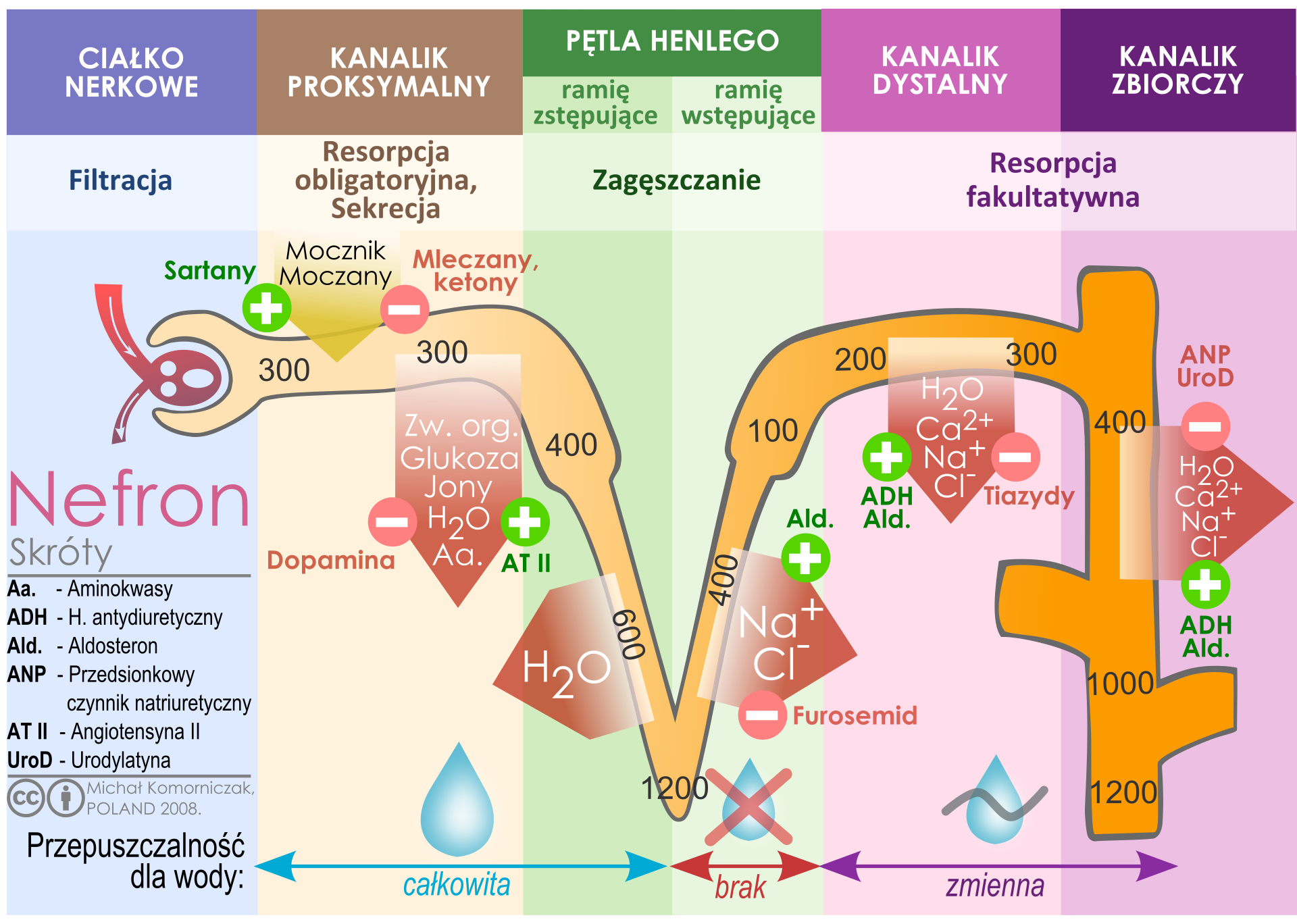
1. The glomerulus — filtration
Blood enters a tuft of capillaries called the glomerulus, sitting inside Bowman's capsule. Pressure forces water and small solutes out of the blood and into the tubule as "filtrate," while cells and large proteins stay behind. The rate of this is the glomerular filtration rate (GFR) — the key measure of kidney function.
2. The proximal convoluted tubule — bulk reabsorption
Most of the useful stuff is reclaimed here: the majority of water, sodium, glucose, amino acids and bicarbonate are reabsorbed back into the blood. Normally all filtered glucose is reabsorbed — glucose appears in urine only when blood levels are very high (as in diabetes).
3. The loop of Henle — concentrating urine
The loop dips into the salty medulla and sets up a concentration gradient that lets the kidney produce concentrated urine and conserve water. Loop diuretics (e.g. furosemide) act here, which is why they are so powerful.
4. The distal convoluted tubule — fine tuning
Here sodium, potassium and calcium handling is fine-tuned under hormonal control. Thiazide diuretics act on this segment.
5. The collecting duct — final water control
The collecting duct adjusts the final water content of urine under the control of antidiuretic hormone (ADH): more ADH means more water reabsorbed and more concentrated urine. Aldosterone also acts here to retain sodium and excrete potassium.
Why this matters clinically
Almost every diuretic, much of blood-pressure control, and the handling of potassium and acid–base balance can be mapped onto these segments. Learn the nephron once, and a huge amount of renal medicine and pharmacology falls into place.
Learn anatomy with the diagram
Ask Aboy AI about the nephron or kidney function and get a cited explanation alongside a labelled diagram.
Try Aboy AI freeFrequently asked questions
What is the functional unit of the kidney?
The nephron — each kidney contains roughly a million nephrons, each filtering blood and producing urine.
Where do loop diuretics act?
On the thick ascending limb of the loop of Henle, where they block sodium reabsorption — producing a strong diuretic effect.
This article is for education only and is not medical advice.